Introduction
Building a successful mobile application involves much more than developing an attractive interface or launching it on an app store. Businesses need a clear strategy, a reliable technical foundation, and a development process that supports long-term growth. This is where the journey from a Minimum Viable Product (MVP) to a full-scale mobile application becomes important.
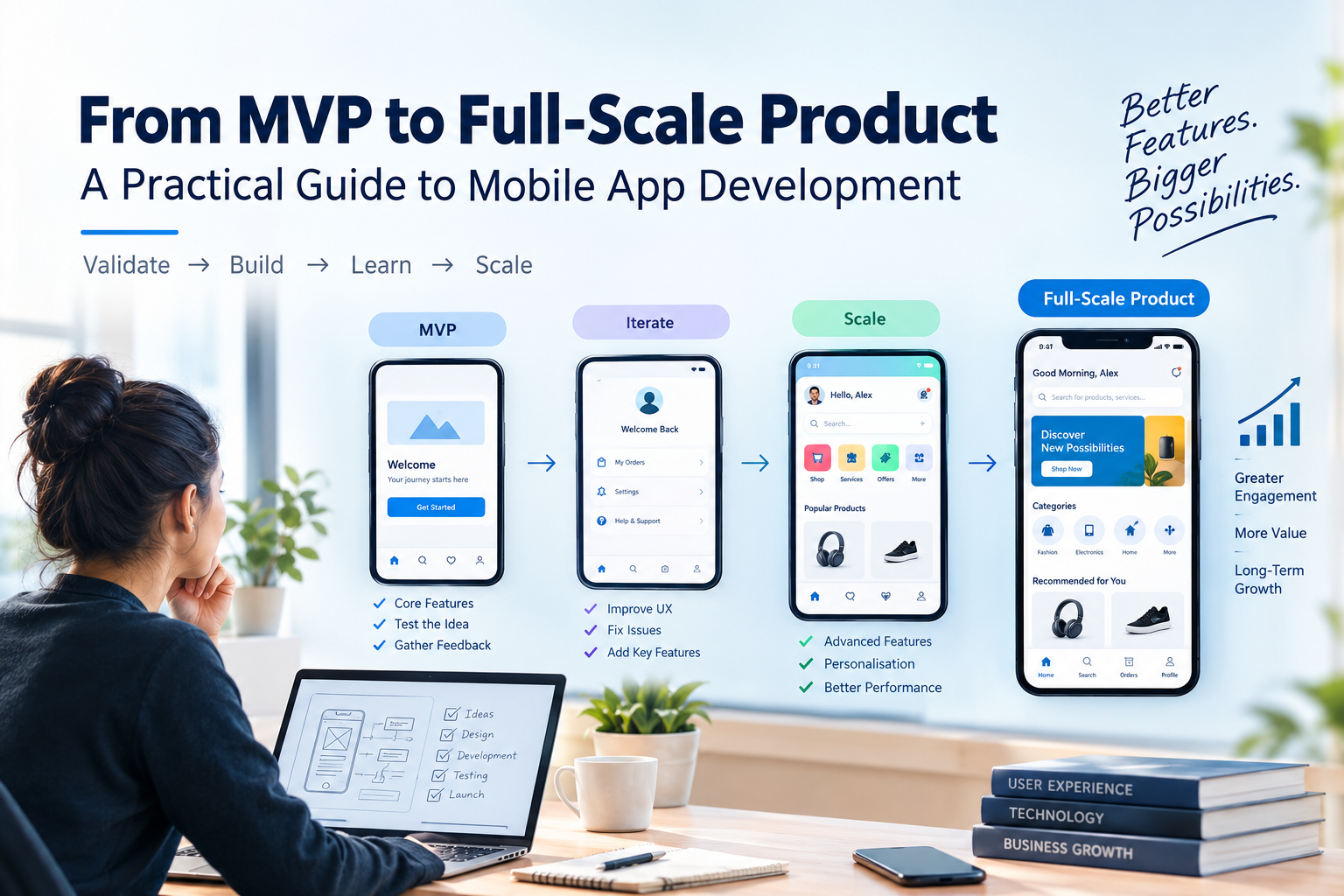
An MVP allows businesses to test their ideas with essential features, gather feedback from real users, and validate market demand before making significant investments. Once the concept proves successful, the application can evolve into a comprehensive digital product. Understanding each stage helps businesses reduce risks, manage development costs, and create better user experiences.
What Is a Minimum Viable Product (MVP)?
A Minimum Viable Product is an initial version of a mobile application that includes only the core features required to solve a specific user problem. Its primary purpose is to test the business idea and understand how users respond to the solution.
For example, an emerging e-commerce business might begin with product listings, user registration, a shopping cart, and a basic checkout process. Advanced recommendations, loyalty programmes, and extensive analytics can be introduced later.
Developing an MVP helps businesses validate assumptions, collect meaningful feedback, and identify opportunities for improvement. Instead of spending months building every possible feature, companies can launch faster and make decisions based on actual user behaviour. Step
1: Define Your Business Goals and Target Audience
Every successful mobile application begins with a clear understanding of its purpose. Before starting development, identify the problem your app will solve and the audience it will serve. Consider these essential questions:
1.Who are your target users?
2.What challenges will the application address?
3.What makes your solution different from existing alternatives?
4.What business objectives should the app achieve?
5.How will success be measured?
Defining these goals helps establish the application's scope and prevents unnecessary features from increasing complexity. Clear objectives also help developers, designers, and business stakeholders work towards the same outcome.
Step 2: Identify and Prioritise Core Features
Feature prioritisation is one of the most important stages of MVP development. Adding too many features during the initial phase can increase costs, extend timelines, and make testing more complicated.
Start by separating essential functionality from features that can be introduced later. Prioritise capabilities that directly address the primary user problem and deliver immediate value.
For instance, a service-booking application may initially require user accounts, service listings, appointment scheduling, payment integration, and booking notifications. Advanced reporting, personalised recommendations, and additional automation can follow once the basic experience has been validated.
A focused MVP makes development more manageable while providing a strong foundation for future improvements.
Step 3: Choose the Right Technology and Development Approach
The technology stack influences application performance, scalability, maintenance, and development costs. Businesses should select technologies according to their requirements rather than following trends without evaluating their suitability.
Native development uses platform-specific technologies for Android and iOS, offering greater control over platform capabilities. Cross-platform frameworks such as Flutter and React Native can help businesses build applications for multiple platforms while sharing significant portions of their codebase.
The right approach depends on the application's complexity, performance requirements, budget, available expertise, and future roadmap.
Businesses should also consider backend architecture, database design, APIs, cloud infrastructure, and security from the beginning. A well-planned technical foundation makes it easier to introduce new features without repeatedly rebuilding the application.
Step 4: Design, Develop, and Test the MVP
User experience plays a significant role in whether people continue using a mobile application. Simple navigation, clear layouts, responsive interfaces, and accessible design help users complete tasks without unnecessary friction.
Once the design is established, developers build the essential features and connect the frontend with backend services. Testing should take place throughout development, covering functionality, performance, compatibility, security, and usability.
Before launch, test the application across relevant devices and operating system versions. Identify and resolve critical bugs, verify important user journeys, and ensure that data is handled securely.
A stable MVP provides a more reliable basis for gathering feedback and planning future development.
Step 5: Launch, Collect Feedback, and Measure Performance
Launching the MVP is the beginning of the learning process, not the end of development. Real-world usage reveals how people interact with the application and which features need improvement.
Businesses should monitor relevant performance indicators, including:
1.User acquisition and registration rates
2.Daily and monthly active users
3.User retention and engagement
4.Conversion rates and completed transactions
5.Crash reports and application performance
6.Customer feedback and support requests
Analytics tools, usability testing, surveys, and customer interviews can help identify friction points. These insights allow businesses to distinguish between features users genuinely need and those that offer limited value.
Step 6: Scale from MVP to a Full-Scale Product
Once the application demonstrates consistent user interest and a viable business opportunity, the next step is strategic expansion. Scaling should be guided by evidence, business priorities, and technical readiness.
This stage may include introducing advanced features, improving personalisation, supporting additional languages, integrating third-party services, and expanding payment options. Businesses may also need stronger infrastructure, improved database performance, automated testing, and more comprehensive monitoring as usage increases.
Security must remain a priority throughout this transition. Regular updates, access controls, secure API integrations, data protection measures, and vulnerability assessments help protect users and business information.
Importantly, scaling does not mean adding every requested feature. It means improving the product in ways that support user satisfaction, operational efficiency, and sustainable growth.
Common Mistakes to Avoid During Mobile App Development
Businesses can face unnecessary delays and expenses when they overlook planning or user feedback. Common mistakes include developing too many features before validating demand, choosing technology without considering long-term needs, neglecting security, and launching without adequate testing.
Another frequent mistake is treating an MVP as a low-quality product. Although the initial version should remain focused, its core functionality must be dependable and easy to use. Avoiding these pitfalls helps businesses make informed investments and establish a more sustainable development process.
Conclusion
Moving from an MVP to a full-scale mobile application requires continuous learning, thoughtful planning, and a technology strategy that supports changing business needs. By validating the concept, prioritising essential features, selecting appropriate technologies, and using real user feedback, businesses can develop digital products with greater confidence. Softechedge helps businesses approach technology with a focus on practical solutions, digital transformation, and sustainable growth. With the right development strategy and technical expertise, your mobile app can evolve from an initial idea into a scalable digital product designed to meet long-term business goals.
Ready to turn your mobile app idea into a scalable solution? Connect with Softechedge to explore mobile app development solutions aligned with your business needs.