Introduction
In the FMCG and manufacturing industries, sales teams play a critical role in driving revenue, expanding market reach, building customer relationships, and maintaining a competitive advantage. From managing distributors and retailers to developing new business opportunities, sales professionals directly influence an organisation's growth and profitability.
However, hiring the right sales talent can be challenging. Companies need professionals who understand their products, communicate effectively, negotiate confidently, and consistently achieve targets. A well-planned recruitment strategy helps businesses attract capable candidates and build high-performing sales teams that deliver sustainable results.
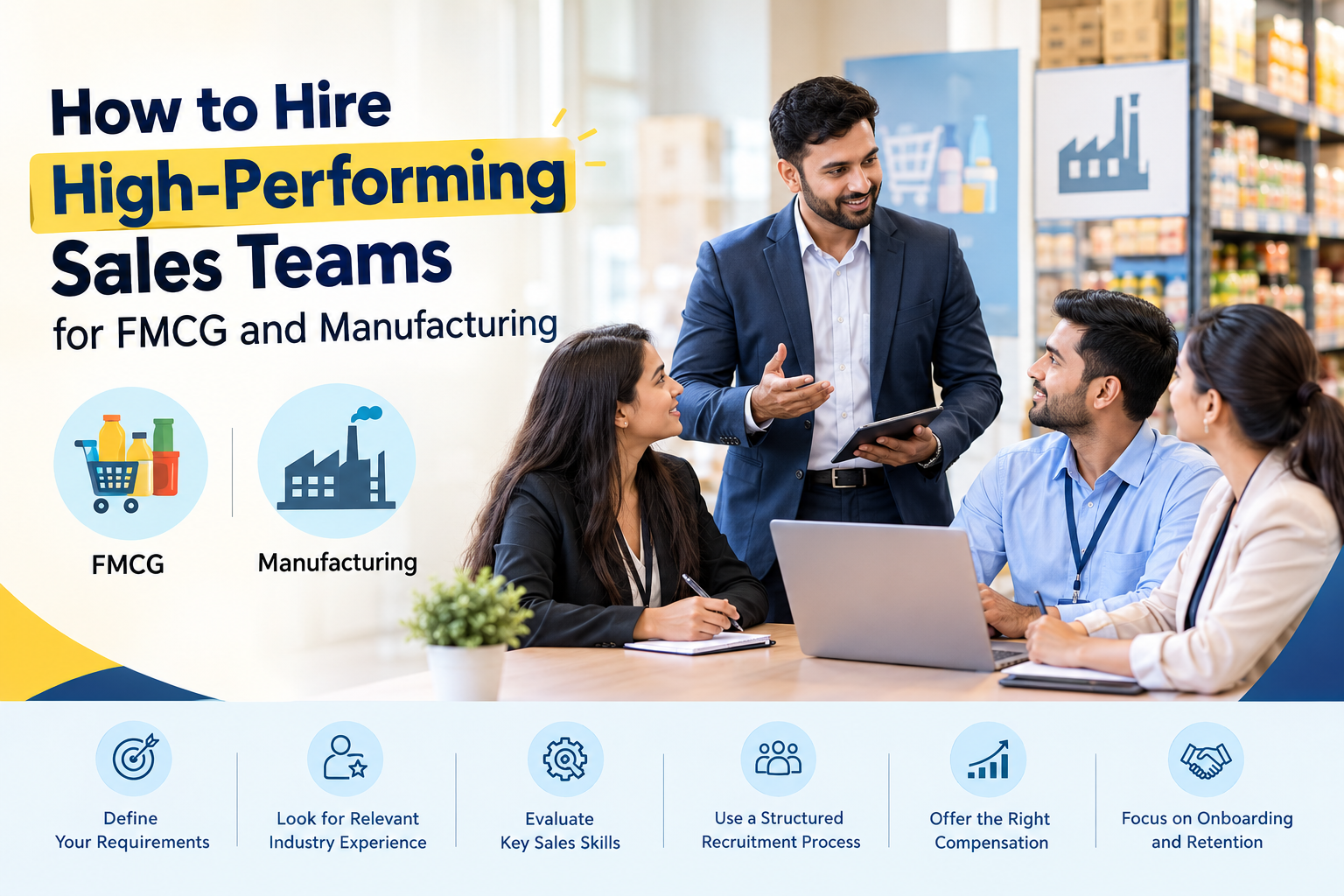
Define Your Sales Hiring Requirements
The first step towards successful recruitment is identifying the specific requirements of your sales team. FMCG and manufacturing businesses often have different sales structures, responsibilities, and customer expectations.
FMCG companies may require sales representatives, territory sales executives, area sales managers, and distribution professionals who can manage retail outlets, monitor product availability, and increase market penetration. Manufacturing companies may need business development executives, industrial sales representatives, key account managers, and technical sales professionals who understand complex products and B2B relationships. Before starting recruitment, define the job responsibilities, required experience, geographical coverage, sales targets, and reporting structure. Clear expectations help recruiters identify candidates whose skills align with business objectives.
Prioritise Relevant Industry Experience
Industry experience can significantly influence a sales professional's ability to perform effectively. Candidates familiar with the FMCG sector may understand distributor networks, retail execution, trade schemes, merchandising, and territory management. Similarly, manufacturing sales professionals may have experience with industrial buyers, product specifications, procurement teams, and long sales cycles.
However, employers should not rely exclusively on industry background. Candidates with strong transferable skills, a willingness to learn, and a proven record of achieving targets can also become valuable team members.
Evaluate candidates based on their previous responsibilities, measurable achievements, customer-handling abilities, and understanding of the relevant market.
Evaluate Essential Sales Skills
A high-performing sales team requires more than product knowledge. Recruiters should assess a combination of interpersonal, analytical, and commercial skills.
Important skills to evaluate include:
1.Communication: The ability to explain product benefits clearly and build customer trust.
2.Negotiation: Confidence in discussing prices, handling objections, and closing deals.
3.Relationship management: The ability to maintain long-term relationships with distributors, retailers, and business clients.
4.Market knowledge: Understanding customer behaviour, competitors, and local market conditions.
5.Target orientation: A consistent focus on achieving sales objectives.
6.Problem-solving: The ability to address customer concerns and overcome sales challenges.
7.Data analysis: Understanding sales reports, territory performance, and market opportunities.
Structured interviews and practical assessments can help employers determine whether candidates possess these essential capabilities.
Use a Structured Recruitment Process
An organised hiring process improves candidate evaluation and reduces the risk of unsuitable appointments. Businesses should establish clear selection stages before advertising vacancies. Start by creating an accurate job description and advertising the position through relevant recruitment platforms, professional networks, and employee referrals. Screen applications for relevant experience, achievements, and essential qualifications.
Shortlisted candidates should then participate in structured interviews that explore their previous performance and approach to sales challenges. Practical exercises, such as preparing a territory expansion plan, handling a customer objection, or presenting a product, can provide additional insight into their abilities.
Using consistent evaluation criteria across candidates makes recruitment more objective and helps hiring managers make informed decisions.
Assess Performance Through Measurable Results
Sales recruitment should focus on demonstrated performance rather than impressive interview answers alone. Employers should ask candidates to explain their previous targets, achievements, territory responsibilities, and contribution to business growth.
Relevant performance indicators may include revenue generated, target achievement percentage, customer acquisition, distribution expansion, customer retention, and average deal value.
For FMCG roles, employers can explore experience in outlet coverage, distributor management, product availability, and sales growth. For manufacturing positions, useful indicators may include new business acquisition, account development, order value, conversion rates, and customer retention.
Candidates should be evaluated in context, considering market conditions, available resources, and the responsibilities of their previous roles.
Build an Attractive Compensation and Incentive Structure
Competitive compensation is essential for attracting and retaining talented sales professionals. A well-designed package may include a fixed salary, performance-based incentives, travel allowances, insurance benefits, and opportunities for career advancement.
Incentive plans should reward meaningful business outcomes rather than encouraging short-term sales at the expense of profitability or customer relationships. For example, organisations may consider revenue growth, target achievement, collection performance, new account acquisition, and customer retention when designing performance-linked rewards.
Clear communication about salary, incentives, targets, and promotion opportunities helps candidates understand the value of joining the organisation.
Leverage Recruitment Technology and Professional Expertise
Technology can make sales recruitment more efficient by helping employers organise applications, screen relevant profiles, track interview progress, and maintain candidate databases. Applicant Tracking Systems (ATS) can support these activities and improve coordination between recruiters and hiring managers.
Professional recruitment partners can also help businesses access relevant talent pools, identify candidates with specialised industry experience, and manage recruitment for multiple locations or positions.
For organisations expanding into new territories or scaling their sales operations, recruitment support can reduce administrative pressure and allow internal teams to focus on core business priorities.
Focus on Onboarding and Long-Term Retention
Hiring the right candidate is only the beginning. Effective onboarding helps new sales employees understand the organisation's products, sales processes, customer expectations, and performance standards.
Provide product training, territory information, sales tools, and clear performance goals. Assign experienced mentors where possible and schedule regular feedback sessions during the initial months.
Managers should also review workload, incentive fairness, career progression, and employee engagement. A supportive work environment encourages sales professionals to improve their performance and build long-term relationships with customers.
Conclusion
Hiring high-performing sales teams for FMCG and manufacturing requires a strategic approach that combines clear role definitions, industry understanding, structured assessments, measurable performance evaluation, and effective retention practices.
Businesses that invest in the right recruitment process are better positioned to expand their markets, strengthen customer relationships, and achieve sustainable sales growth. Whether an organisation needs field sales executives, territory managers, or experienced B2B sales professionals, selecting candidates who align with its business goals remains essential. Jobsglint helps connect employers with talent and supports recruitment efforts through a focus on relevant candidate profiles and hiring needs. With the right recruitment strategy and professional support, businesses can build capable sales teams prepared to meet evolving market demands.