Introduction
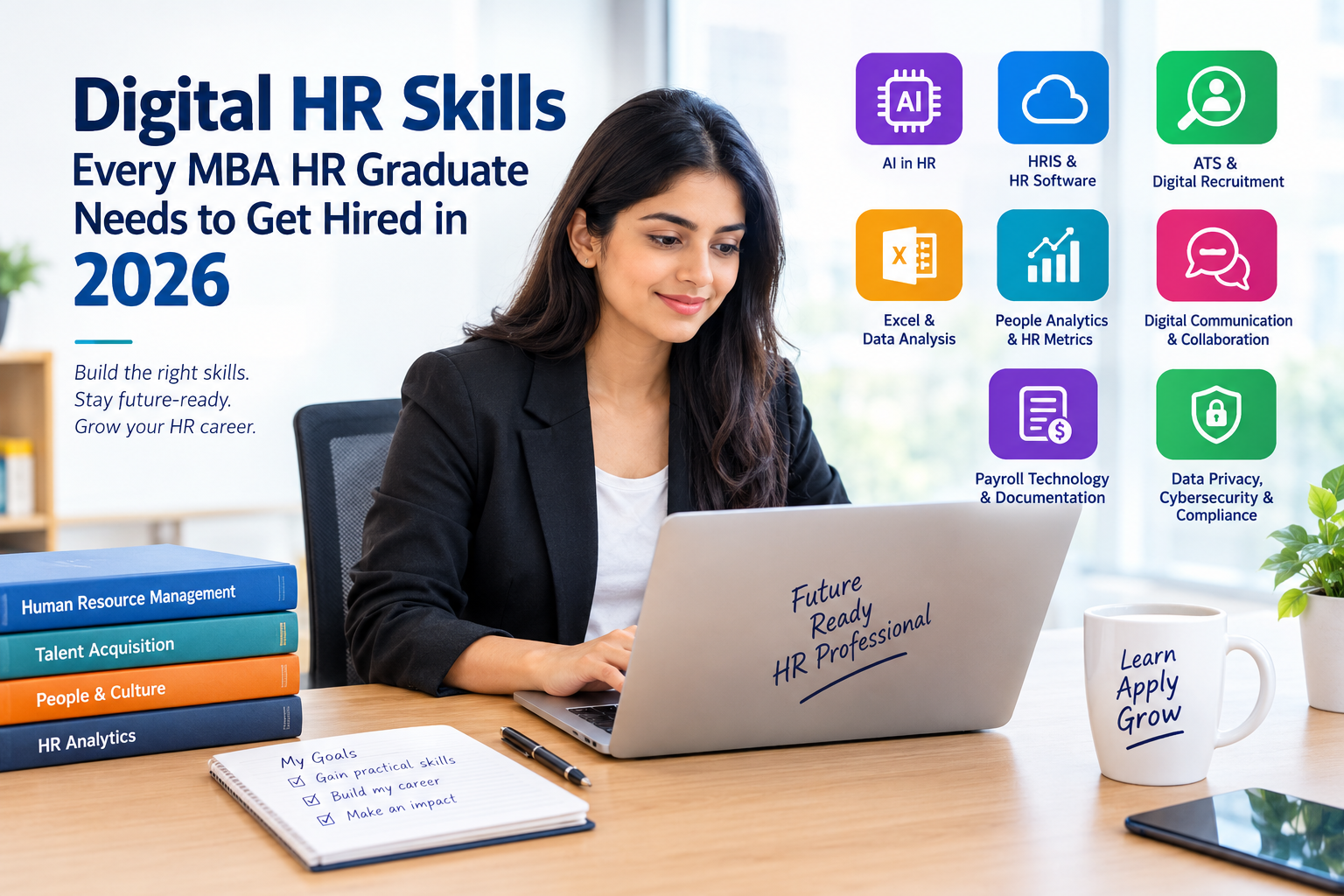
The world of Human Resource Management is changing rapidly as organizations adopt artificial intelligence, automation, cloud-based platforms, and data-driven decision-making. Today, an MBA in Human Resources provides a strong foundation in people management, but employers increasingly value candidates who can combine HR knowledge with practical digital skills.
For MBA HR graduates entering the job market in 2026, understanding modern HR technology can improve workplace readiness and open doors to opportunities in recruitment, HR operations, talent management, and employee engagement.
Whether you are a fresher or looking to advance your career, developing the right digital HR skills can help you stand out in a competitive job market. Let's explore the essential skills every aspiring HR professional should consider learning.
Artificial Intelligence (AI) in Human Resource Management
Artificial intelligence is becoming an important part of modern HR operations. Organizations use AI-powered tools to assist with recruitment, employee communication, workforce planning, and routine administrative tasks.
MBA HR graduates should understand how AI can support HR activities while recognizing its limitations. AI tools can help draft job descriptions, prepare interview questions, organize information, and summarize employee feedback.
However, HR professionals must review AI-generated content for accuracy, fairness, privacy, and potential bias. Human judgment remains essential when making employment decisions.
Key skills to develop:
1.Using AI assistants for routine HR documentation.
2.Drafting job descriptions and interview questions.
3.Understanding responsible and ethical AI use.
4.Reviewing AI-generated information before applying it.
HR Management Software and HRIS
Human Resource Information Systems (HRIS) help organizations maintain employee information and manage important HR processes through centralized digital platforms. Depending on the software, these systems may support attendance tracking, leave management, onboarding, employee records, payroll workflows, and performance reviews. MBA HR graduates should become familiar with how HR software works, even if their first employer uses a different platform.
Key skills to develop:
1.Maintaining digital employee records.
2.Understanding employee onboarding workflows.
3.Managing leave and attendance information.
4.Learning the basics of HR dashboards and reporting.
Practical exposure to HRIS platforms can help freshers understand how digital systems support everyday HR operations.
Applicant Tracking Systems (ATS) and Digital Recruitment
Recruitment has become increasingly technology-driven. Many organizations use Applicant Tracking Systems to organize applications, manage candidate information, and coordinate hiring activities.
An understanding of ATS workflows can be particularly valuable for graduates interested in talent acquisition and recruitment.
HR professionals should know how to screen resumes against job requirements, maintain candidate records, schedule interviews, and communicate with applicants professionally.
Key skills to develop:
1.Understanding ATS workflows and candidate pipelines.
2.Learning resume screening and shortlisting techniques.
3.Managing candidate databases responsibly.
4.Tracking recruitment metrics such as time-to-hire.
5.Using job portals and professional networking platforms.
These skills help aspiring recruiters understand the recruitment process from vacancy creation to candidate onboarding.
Advanced Microsoft Excel and HR Data Analysis
Excel remains a useful tool for many HR teams because it supports data organization, reporting, and basic analysis. HR professionals frequently work with employee records, attendance sheets, recruitment trackers, and training reports.
MBA HR graduates who can organize and interpret data may be better prepared to support evidence-based decisions.
Key skills to develop:
1.Sorting, filtering, and validating employee data.
2.Using formulas such as IF, COUNTIF, and SUMIF.
3.Applying lookup functions such as XLOOKUP or VLOOKUP.
4.Creating PivotTables and charts.
5.Preparing recruitment and attendance reports.
Learning these functions can help freshers handle practical HR assignments with greater accuracy and confidence.
People Analytics and HR Metrics
People analytics involves using employee-related data to understand workforce patterns and support organizational decisions. Rather than relying entirely on assumptions, HR teams can analyze measurable information to identify trends and areas for improvement.
For example, recruitment data can help identify delays in hiring, while employee turnover reports can reveal patterns that require further investigation.
MBA HR graduates should understand common HR metrics and their practical applications.
Important metrics include:
1.Employee turnover rate.
2.Time-to-hire and time-to-fill.
3.Cost-per-hire.Absenteeism rate.
4.Employee engagement scores.
5.Training participation and completion rates.
6.The ability to explain what these metrics mean—and what they do not prove—is an important part of responsible HR analysis.
Digital Communication and Collaboration Tools
HR professionals coordinate with employees, candidates, managers, and other departments. Digital communication tools make it easier to conduct interviews, share documents, organize meetings, and coordinate tasks across locations.
Graduates should be comfortable using email, video conferencing, shared documents, calendars, and team collaboration platforms.
Key skills to develop:
1.Writing professional emails and HR announcements.
2.Scheduling interviews and online meetings.
3.Coordinating tasks through collaboration tools.
4.Maintaining confidentiality while sharing information.
5.Communicating clearly with remote and hybrid teams.
Strong digital communication skills can improve coordination and create a more professional experience for candidates and employees.
Payroll Technology and Digital HR Documentation
Payroll and HR administration require accuracy, confidentiality, and attention to detail. Digital payroll systems help organizations process salary information, maintain records, and coordinate statutory deductions according to applicable requirements.
MBA HR graduates do not necessarily need to master every payroll platform, but understanding the fundamentals can improve their readiness for HR operations roles.
Useful skills include maintaining attendance records, checking payroll inputs, organizing employee documentation, and understanding basic salary components and statutory compliance requirements in India.
Practical training should also emphasize secure handling of personal and financial information.
Data Privacy, Cybersecurity, and HR Compliance
HR departments handle sensitive information, including employee contact details, salary records, identity documents, and performance evaluations. Protecting this information is a critical responsibility.
Digital HR professionals should understand access controls, secure document sharing, strong passwords, phishing risks, and appropriate data-handling practices.
They should also develop awareness of applicable Indian employment laws and data-protection requirements, including the Digital Personal Data Protection Act, 2023, and relevant rules and notifications in force.
Responsible data management helps protect employees and supports organizational trust.
How MBA HR Graduates Can Develop These Skills in 2026
Learning digital HR skills becomes more effective when theoretical knowledge is combined with practical exercises.
Graduates can begin by creating a sample recruitment tracker in Excel, preparing a job description with AI assistance, practicing candidate screening, building a basic HR dashboard, and learning the workflow of an HRIS or ATS.
They can also explore internships, entry-level HR roles, workshops, and structured HR training programs to gain practical exposure.
Skill Excellent, a professional skill development training institute in Lucknow, offers an opportunity for aspiring professionals to explore HR training and develop job-oriented knowledge. Interested learners should review the available course curriculum to identify training that matches their career goals and includes relevant practical activities.
Conclusion
In 2026, an MBA in HR combined with digital proficiency can help graduates prepare for the changing demands of human resource management. AI awareness, HR software, ATS workflows, Excel, people analytics, digital communication, and data privacy are valuable areas to develop.
You do not need to master every technology before applying for your first job. Start with the skills relevant to your target role, practice them through realistic assignments, and continue learning as HR technology evolves.
With the right combination of HR fundamentals, practical experience, and digital skills, MBA HR graduates can build a stronger foundation for opportunities in recruitment, HR operations, and talent management.