Introduction
Hiring a large number of employees at the same time can be challenging for any organization. Whether a company is expanding into new locations, opening a new facility, preparing for a seasonal workforce requirement, or scaling its operations, traditional recruitment methods can quickly become time-consuming and difficult to manage.
This is where digital job portals and technology-driven recruitment solutions can make a significant difference. By helping employers reach a wider pool of candidates, manage vacancies, screen applications, and improve communication, digital recruitment platforms can make bulk hiring more organized and efficient.
For businesses looking for scalable workforce solutions, SAC Management India Pvt. Ltd. focuses on connecting talent, technology, and business requirements through its broader growth ecosystem, including recruitment and job-portal solutions.
What Is Bulk Hiring?
Bulk hiring refers to the process of recruiting a large number of employees within a specific period. It is commonly required in industries such as IT, retail, manufacturing, BPO, logistics, hospitality, healthcare, and other sectors where organizations regularly need multiple employees for similar or different positions.
Unlike individual recruitment, bulk hiring involves handling numerous job openings and candidate applications simultaneously. This requires a structured process that can manage high volumes without compromising the quality of hiring.
Why Traditional Bulk Recruitment Can Be Challenging
Recruiting at scale involves more than simply posting a vacancy. Employers may receive hundreds or even thousands of applications, making manual screening difficult.
Recruitment teams often have to deal with:
1.High volumes of resumes
2.Repetitive candidate screening
3.Multiple job openings
4.Limited candidate reach
5.Time-consuming communication
6.Interview scheduling challenges
7.Difficulty tracking applicants
8.Delays in shortlisting suitable candidates
When these processes are handled manually, recruiters may spend significant time on administrative tasks instead of focusing on candidate evaluation and engagement.
How Digital Job Portals Simplify Large-Scale Recruitment
Digital job portals provide a centralized environment where employers can publish vacancies and connect with potential candidates. Instead of relying on disconnected recruitment channels, organizations can use digital platforms to make different stages of hiring more structured.
A job portal can help employers improve vacancy visibility, attract relevant applicants, organize candidate information, and simplify the overall recruitment workflow.
For businesses conducting bulk hiring, this scalability can be particularly valuable.
1. Wider Reach for Job Vacancies
One of the biggest advantages of digital job portals is the ability to reach a broad candidate audience.
Instead of depending only on local recruitment drives or individual applications, employers can make vacancies visible to job seekers across different cities, regions, and professional backgrounds.
For organizations hiring for multiple locations, this wider reach can help create a larger and more diverse candidate pool.
2. Multiple Vacancies Can Be Managed More Efficiently
Bulk recruitment often means hiring for several positions simultaneously. A digital recruitment platform can make it easier to organize these requirements according to job role, location, experience, skills, and other criteria.
This allows recruitment teams to maintain better visibility over their open positions and candidate pipelines.
A structured digital approach can also reduce confusion when multiple recruiters or hiring managers are working on different vacancies.
3. Faster Candidate Discovery
Finding relevant candidates is one of the most important parts of bulk hiring. Digital platforms can help recruiters discover candidates based on job-related requirements such as skills, qualifications, experience, and location.
This can make the initial talent-discovery process more focused and reduce the time spent reviewing applications that do not match the vacancy.
4. Streamlined Resume Screening
When hundreds of applications arrive for a vacancy, manually reviewing every resume can put significant pressure on recruitment teams.
Modern recruitment platforms can support technology-enabled resume screening and filtering, helping recruiters identify profiles that align more closely with predefined requirements.
While technology can assist with initial screening, human evaluation remains important for understanding candidate suitability, communication skills, cultural fit, and other factors that may not be fully reflected in a resume.
5. Better Candidate Management
Bulk hiring requires recruiters to keep track of a large number of applicants. Digital systems can help organize candidate information and make it easier to monitor different stages of the recruitment process.
Recruiters can work with a clearer pipeline, from application and screening to interviews and final selection.
Better organization can also improve the candidate experience by reducing unnecessary delays and communication gaps.
6. Improved Hiring Efficiency
Time is a critical factor in large-scale recruitment. When businesses need employees quickly, lengthy hiring cycles can affect operations and growth.
Digital job portals can help reduce administrative workload by making vacancy management, candidate discovery, application handling, and recruitment coordination more systematic.
This enables recruitment teams to spend more time on activities that require human judgment and relationship-building.
JobsGlint: Supporting Smarter Digital Recruitment
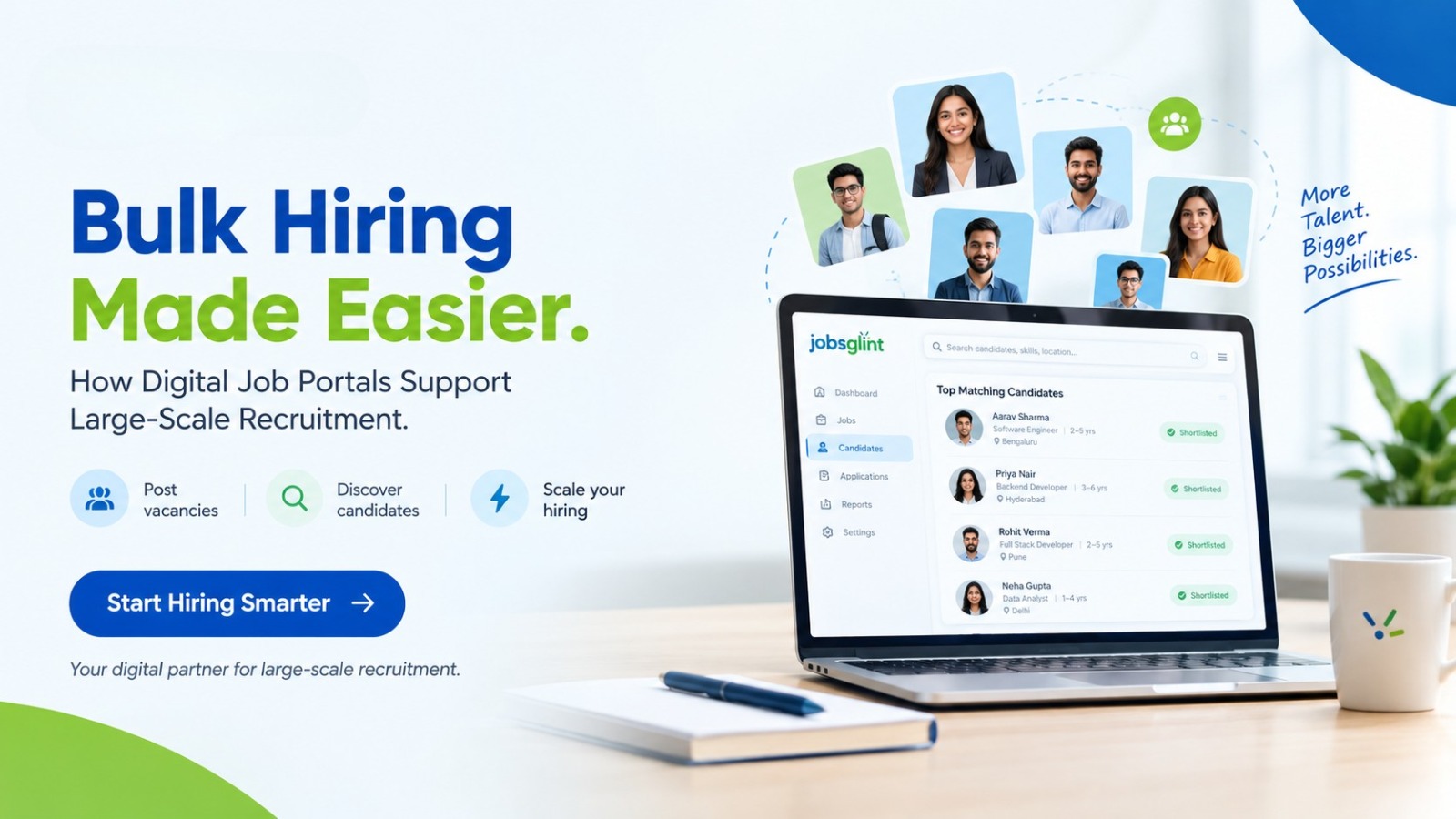
As part of the SAC Management India Pvt. Ltd. ecosystem, JobsGlint supports the connection between employers and job seekers through a digital job-portal approach.
For employers, platforms such as JobsGlint can provide an avenue to publish vacancies, improve candidate reach, and connect with relevant job seekers. For candidates, a digital job portal creates opportunities to discover vacancies and apply for roles that match their skills and career goals.
The broader objective is to make recruitment more accessible, organized, and technology-enabled for both sides of the employment ecosystem.
The Future of Bulk Hiring Is Digital
As businesses continue to grow and workforce requirements become more dynamic, recruitment needs to become faster without losing focus on candidate quality.
Digital job portals are helping organizations move from fragmented hiring processes toward more connected and data-supported recruitment workflows. Technologies such as AI-assisted screening, automated communication, digital candidate management, and smarter job matching are likely to play an increasingly important role in the future of hiring.
However, technology should support—not replace—the human side of recruitment. Successful hiring still depends on understanding people, skills, organizational requirements, and long-term potential.
Conclusion
Bulk hiring does not have to mean overwhelming recruitment teams with endless resumes and administrative work. With the right digital job portal and recruitment strategy, organizations can improve candidate reach, streamline hiring processes, manage large applicant volumes, and make recruitment more efficient.
For businesses seeking scalable workforce solutions, SAC Management India Pvt. Ltd. brings together talent solutions, skills, and technology as part of a broader growth ecosystem. Through platforms and services such as JobsGlint, the focus remains on helping employers connect with relevant talent while creating better opportunities for job seekers.
Smarter recruitment starts with the right combination of technology, talent, and strategy.