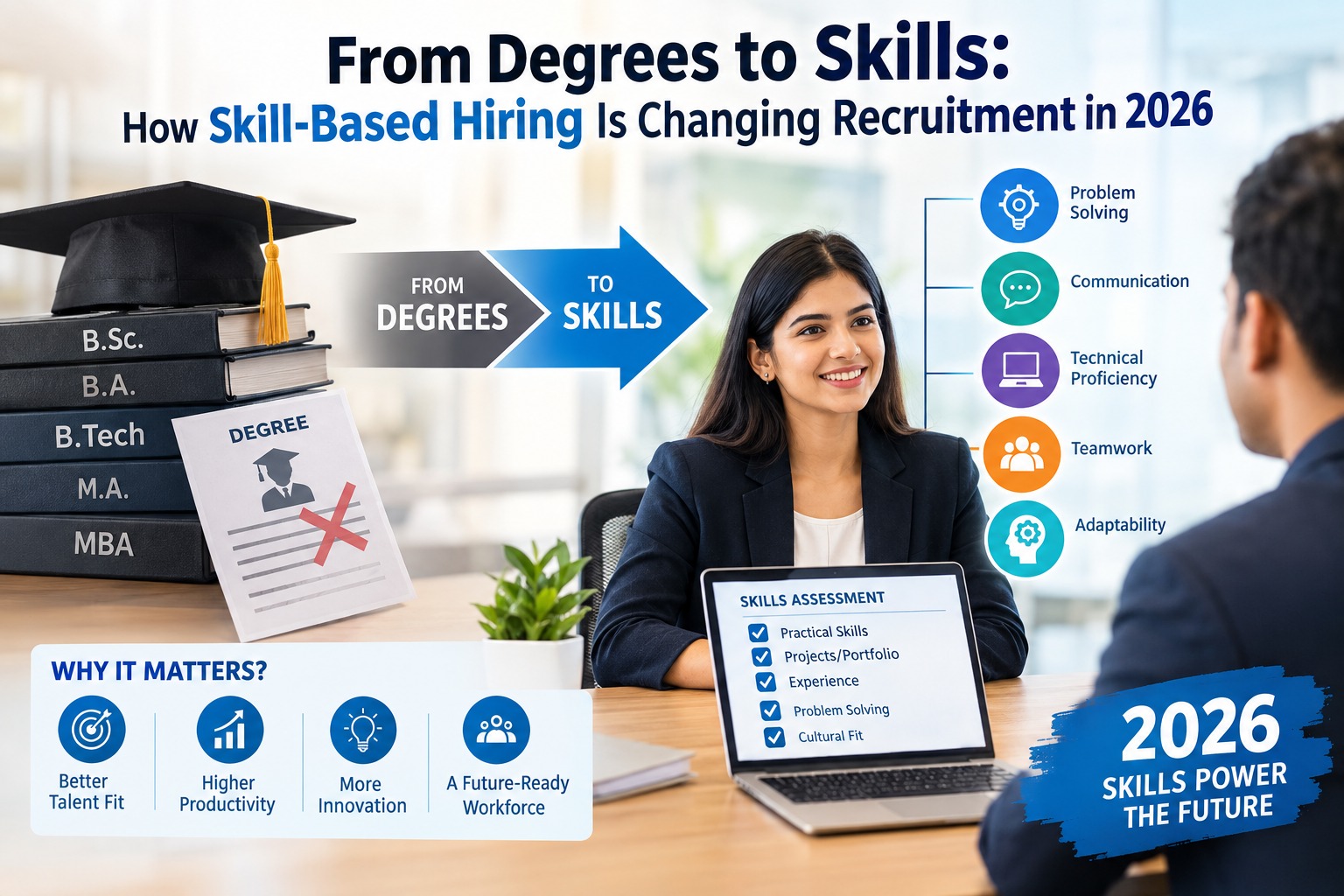
Introduction
The hiring landscape is changing rapidly. For years, academic degrees and formal qualifications were among the first things employers looked at when evaluating candidates. But in 2026, organisations are increasingly asking a different question: “What can this candidate actually do?”
This shift from degree-based hiring to skill-based hiring is changing how companies identify, evaluate and recruit talent. Employers are placing greater emphasis on practical capabilities, problem-solving, adaptability, digital proficiency and role-specific skills rather than relying solely on educational credentials.
For businesses looking to build capable and future-ready teams, this approach can create access to a wider and more diverse talent pool.
What Is Skill-Based Hiring?
Skill-based hiring is a recruitment approach where candidates are evaluated primarily on the capabilities required to perform a particular job. Education and qualifications may still matter, especially for regulated professions, but they are no longer necessarily the only indicators of suitability.
For example, a digital marketing role may require SEO knowledge, analytics, content creation and campaign management. A candidate with strong practical experience in these areas may be valuable even if their academic background is not directly related to marketing.
The focus therefore moves from “What degree do you have?” to “What skills can you demonstrate?”
Why Is Skill-Based Hiring Growing in 2026?
Technology and changing business requirements are making traditional hiring models less effective. Job roles are evolving quickly, and new skills are emerging across industries.
Employers increasingly need professionals who can work with digital tools, analyse information, communicate effectively and adapt to changing processes. In such an environment, a degree earned several years ago may not fully demonstrate a candidate's current capabilities.
Skill-based recruitment allows organisations to assess candidates based on what is relevant today.
It can also help employers discover candidates who have developed valuable skills through certifications, professional training, internships, freelance projects, apprenticeships or hands-on experience.
The Rise of Practical Skills
One of the biggest changes in recruitment is the growing importance of practical knowledge.
Employers want people who can contribute to real business objectives. Instead of simply listing qualifications on a resume, candidates increasingly need to demonstrate how they have applied their knowledge.
For instance, an IT candidate can showcase applications they have developed, a sales professional can demonstrate achievements against targets, and an HR candidate can highlight experience with recruitment processes, HRMS platforms or payroll operations.
Proof of ability is becoming an important part of employability.
AI Is Influencing Modern Recruitment
Artificial intelligence is also transforming how companies identify talent. AI-powered recruitment tools can help employers analyse resumes, identify relevant skills, shortlist candidates and improve candidate-job matching. However, technology works best when recruitment teams clearly understand what skills a particular role actually requires.
For organisations, this means creating detailed job descriptions based on skills, responsibilities and measurable outcomes, rather than focusing only on educational qualifications.
At the same time, human judgement remains important for evaluating communication, cultural fit, motivation, leadership and other qualities that technology cannot completely capture.
Benefits for Employers
Skill-based hiring can provide several advantages to businesses.
1. Wider Talent Pool
Removing unnecessary degree requirements can help organisations reach candidates from different educational and professional backgrounds.
2. Better Role Alignment
When recruitment focuses on job-specific competencies, employers can identify candidates whose capabilities closely match the actual requirements of the position.
3. Faster Hiring
Clearly defined skill requirements can make screening and shortlisting more focused, helping recruitment teams reduce unnecessary applications and save time.
4. Greater Workforce Agility
Employees with adaptable and transferable skills may be better positioned to learn new technologies and respond to changing business needs.
5. More Focus on Performance
Skill-based hiring encourages organisations to connect recruitment with measurable capabilities and expected outcomes.
What This Means for Job Seekers
The shift towards skills-based recruitment also changes how candidates should approach their careers.
A resume should not simply be a list of degrees and job titles. Candidates should highlight relevant skills, practical achievements, projects, certifications and measurable results.
For freshers, internships, academic projects, portfolios and industry-focused training can help demonstrate practical capabilities.
For experienced professionals, showcasing achievements and transferable skills can be particularly useful when applying for new roles or changing careers.
Candidates should also continue learning. Digital transformation means that skills that are valuable today may evolve tomorrow. Continuous upskilling and reskilling can therefore become an important part of long-term career growth.
The Role of Recruitment Partners
As hiring becomes more skills-focused, organisations may need recruitment partners that understand both business requirements and changing talent trends.
At SAC Management India Pvt. Ltd., recruitment can be approached as more than simply matching resumes with vacancies. Understanding the role, identifying relevant capabilities and connecting organisations with suitable talent are essential elements of effective workforce planning.
A skills-oriented approach can help businesses move towards more focused talent acquisition while giving capable professionals opportunities to demonstrate their potential.
Building a Skills-First Workforce
Skill-based hiring does not mean that degrees have become irrelevant. Education continues to provide valuable foundational knowledge and remains essential for many professions.
The real change is that degrees are increasingly becoming one part of the hiring equation rather than the entire equation.
In 2026, businesses that understand what skills their teams need—and know how to identify those skills—can build stronger, more adaptable workforces.
The future of recruitment is moving towards a simple but powerful principle: potential should be measured by capability, not credentials alone.
For organisations, this means hiring smarter. For professionals, it means continuously building and demonstrating relevant skills. And for the recruitment ecosystem, it means creating a stronger connection between education, skills, opportunity and business growth.