Introduction
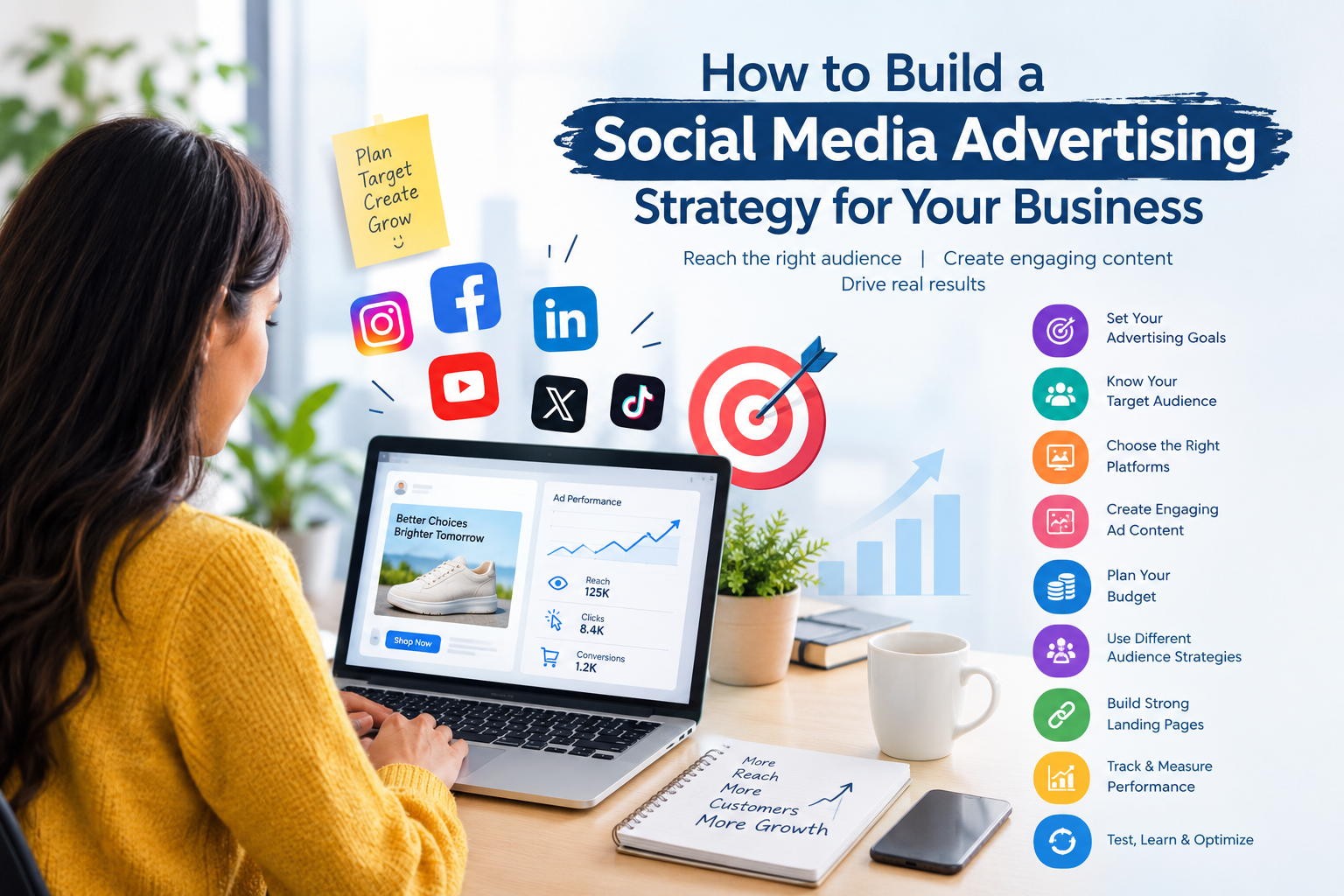
Social media has become more than a platform for sharing updates, photos, and videos. For businesses, it is now an important channel for reaching potential customers, building brand awareness, generating leads, and driving sales. However, simply running advertisements on social media does not guarantee results. Businesses need a clear strategy that connects advertising goals, audience targeting, creative content, and performance measurement.
A well-planned social media advertising strategy helps businesses spend their advertising budget more effectively while reaching people who are more likely to engage with their products or services. Whether you are a startup, small business, or established company, the following steps can help you create a practical social media advertising strategy.
Define Your Advertising Goals
The first step is to understand what you want your advertising campaign to achieve. Different goals require different campaign approaches.
Your objective could be:
1.Increasing brand awareness
2.Generating leads
3.Driving website traffic
4.Promoting a product or service
5.Increasing online sales
6.Growing app downloads
7.Getting enquiries or registrations
For example, a business launching a new service may initially focus on awareness, while an e-commerce company may prioritize conversions and sales.
Clear goals also make it easier to measure whether your campaign is actually delivering results.
Understand Your Target Audience
One of the biggest advantages of social media advertising is the ability to target specific audiences. Instead of showing your advertisements to everyone, you can focus on people who are more relevant to your business.
Start by identifying your ideal customer based on factors such as:
1.Age
2.Location
3.Interests
4.Profession
5.Purchasing behaviour
6.Online activities
7.Business needs
For B2B businesses, factors such as industry, job role, company size, and professional interests can also be important.
Understanding your audience helps you create advertisements that address their actual problems rather than simply promoting your product.
Choose the Right Social Media Platforms
Not every business needs to advertise on every platform. The right choice depends on your audience, industry, content format, and advertising objectives.
For example, Instagram and Facebook can be useful for visually driven consumer campaigns, while LinkedIn can be more relevant for B2B services and professional audiences. YouTube can be effective when video plays an important role in explaining a product, service, or idea.
Instead of spreading your budget across multiple platforms without a clear purpose, identify where your potential customers are most active and begin there.
Create Relevant and Engaging Ad Content
Your advertisement has only a few seconds to capture attention. Therefore, your creative content needs to be clear, relevant, and visually appealing.
A strong social media advertisement generally includes:
1.A clear message
2.An attention-grabbing visual or video
3.A relevant headline
4.A simple value proposition
5.A strong call to action
Rather than focusing only on product features, explain how your product or service can solve a problem or provide value.
For example, instead of saying, "We provide digital marketing services," a business could communicate, "Turn website traffic into measurable business opportunities with a smarter digital strategy."
Set a Realistic Advertising Budget
Your advertising budget should be connected to your business goals and expected results. There is no universal budget that works for every company.
Start with a manageable amount and monitor the campaign's performance. Based on the results, you can gradually increase spending on campaigns and audiences that are delivering meaningful outcomes.
It is also important to distinguish between spending more and spending effectively. A larger budget cannot compensate for poor targeting, weak creative content, or an ineffective landing page.
Use Different Audience Strategies
Social media advertising becomes more effective when businesses understand the difference between new and existing audiences.
Cold audiences are people who may not know your business yet. Awareness-focused content can help introduce your brand to them.
Warm audiences have already interacted with your content, website, or social media profile. Retargeting can help keep your business visible to these users.
Existing customers can be approached with campaigns designed around repeat purchases, upgrades, referrals, or related products and services.
Using different messages for different audience groups can make your advertising more relevant.
Connect Ads With a Strong Landing Page
Getting someone to click your advertisement is only one part of the process. What happens after the click is equally important.
Your landing page should match the message and offer presented in the advertisement. It should load quickly, work well on mobile devices, explain the offer clearly, and provide an easy next step.
A confusing landing page can result in lost leads even when the advertisement itself performs well.
8. Track Important Performance Metrics
You cannot improve what you do not measure. Social media advertising platforms provide several metrics that can help businesses understand campaign performance.
Important metrics include:
Impressions: How many times an advertisement was displayed
Reach: Number of unique users who saw the advertisement
CTR: Percentage of people who clicked the advertisement
CPC: Cost per click
CPL: Cost per lead
CPA: Cost per acquisition
ROAS: Revenue generated compared with advertising spend
The most important metrics depend on your campaign objective. A brand awareness campaign may focus more on reach and engagement, while a sales campaign may prioritize conversions and ROAS.
Test, Learn and Optimize
A successful social media advertising strategy is rarely created in one attempt. Businesses should continuously test different elements of their campaigns.
You can experiment with:
1.Different headlines
2.Images versus videos
3.Audience segments
4.Calls to action
5.Offers
6.Ad formats
7.Landing pages
This process, often called A/B testing, helps identify what works better for your audience.
Once you identify strong-performing combinations, you can optimize the campaign and allocate more resources toward them.
Conclusion
Building a successful social media advertising strategy requires more than creating an advertisement and setting a budget. It involves understanding your audience, choosing suitable platforms, developing relevant creative content, creating effective landing pages, tracking meaningful metrics, and continuously optimizing campaigns.
When social media advertising is connected with broader business goals, it can become a measurable growth channel rather than simply another promotional activity. The key is to start with a clear objective, understand your audience, test your approach, and use performance data to make better decisions over time.