Introduction
Artificial Intelligence (AI) has transformed the way people communicate, work, study, and access information. From instant translation tools to AI-powered language tutors, technology has made it easier than ever to understand and translate foreign languages. A conversation that once required years of language study can now be supported by a smartphone or an AI application within seconds.
However, this technological progress has not made foreign language learning irrelevant. In 2026, the value of knowing a foreign language is increasingly connected to human communication, cultural understanding, career development, and professional relationships.
AI can translate words, sentences, and even conversations, but learning a language helps people understand the meaning, context, emotions, and culture behind those words. For students and professionals, this difference can make language skills a valuable addition to technical and digital abilities.
How AI Is Changing Language Learning
AI has introduced several new ways to learn and practise foreign languages. Learners can use AI-powered platforms to practise conversations, receive instant feedback, improve pronunciation, build vocabulary, and identify grammatical mistakes.
AI can also personalise learning. Instead of following exactly the same lesson plan as every other student, learners can practise areas where they need additional support. For example, a student struggling with German vocabulary can generate customised exercises, while someone preparing for a French-speaking interview can practise relevant conversations.
Translation technology has also become increasingly sophisticated. AI tools can help users understand emails, documents, websites, travel information, and everyday conversations in unfamiliar languages.
These developments make language learning more accessible, but they also change what learners should focus on.
AI Can Translate, But Can It Truly Communicate?
Translation and communication are not always the same thing.
A language carries tone, cultural references, humour, social expectations, and emotion. The literal translation of a sentence may be grammatically correct while still missing its intended meaning.
For example, professional communication often requires knowing whether a situation calls for a formal expression, an informal phrase, or a culturally appropriate response. Similarly, humour, idioms, expressions, and local customs may not translate naturally from one language into another.
A person who understands the language can recognise these nuances more naturally and respond accordingly.
This is particularly important in international workplaces, where successful communication involves more than converting words from one language to another.
Human Language Skills Build Cultural Understanding
Learning a foreign language is also a way of learning about another culture.
When students learn French, German, Spanish, Japanese, or another language, they encounter different ways of expressing ideas, interacting socially, and understanding everyday situations. This exposure can develop cultural awareness and help learners communicate respectfully with people from different backgrounds.
AI can provide information about cultural differences, but personal experience through language learning creates a deeper connection.
For students planning to study abroad or professionals working with international teams, this cultural understanding can become an important practical skill.
Foreign Languages Can Strengthen Career Opportunities
The modern workplace is increasingly connected across borders. Companies work with international clients, suppliers, employees, customers, and business partners. As a result, professionals who can communicate in more than one language may be able to participate in a wider range of professional interactions.
Foreign language skills can be useful in areas such as:
1.International business
2.Tourism and hospitality
3.Customer support
4.Aviation
5Education
6.Translation and interpretation
7.Sales and marketing
8.Export and import
9.International recruitment
10.Diplomacy and global services
For a job seeker, language proficiency can complement technical qualifications and communication skills. It can also help candidates demonstrate their ability to work in multicultural environments.
AI and Human Learning Can Work Together
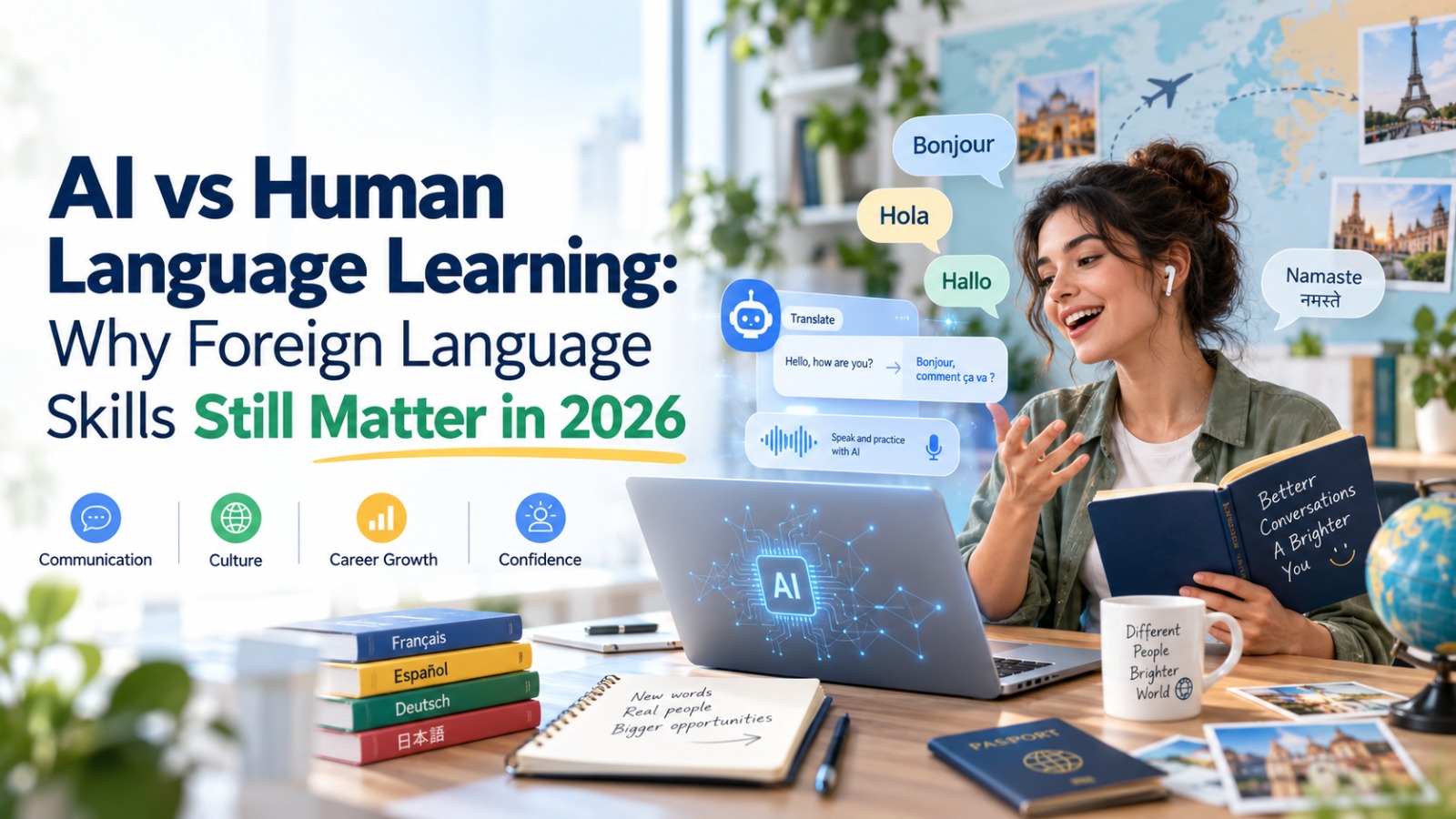
The real question in 2026 is not necessarily AI versus human language learning. A more useful approach is AI plus human learning.
AI can become a powerful learning assistant. Students can use it to practise vocabulary, simulate conversations, generate quizzes, correct basic mistakes, and explore unfamiliar expressions.
At the same time, structured language courses provide elements that technology alone may not consistently provide—such as guided progression, instructor feedback, speaking practice, peer interaction, accountability, and real-world application.
For example, a learner studying German can attend structured classes to develop grammar and speaking fundamentals, while using AI tools between classes for additional vocabulary and conversation practice.
This combination can make the learning process more flexible and practical.
Why Speaking Practice Still Matters
Knowing how to recognise a translated sentence is different from being able to speak naturally.
Speaking a foreign language requires listening, thinking, pronunciation, vocabulary recall, grammar, and confidence—often simultaneously. These abilities develop through repeated practice and real interaction.
Classroom discussions, role plays, presentations, interviews, and conversation exercises can help learners become comfortable using the language spontaneously.
This is especially important for professionals who may need to communicate with international colleagues or clients without relying completely on translation technology.
Language Certifications Still Have Value
Formal language certifications can provide evidence of a learner's proficiency. Certifications such as DELF/DALF for French or recognised German-language examinations can be relevant for education, employment, and other international opportunities, depending on the institution or organisation.
A certificate does not replace practical communication ability, but it can provide a structured benchmark of language proficiency.
For learners with international education or career goals, understanding the language requirements of their target university, employer, or destination is therefore an important part of choosing a course.
The Future of Language Learning
AI will continue to influence foreign language education. Future learners are likely to have access to increasingly personalised tutors, speech recognition, immersive simulations, adaptive exercises, and real-time feedback.
Rather than eliminating language learning, these technologies can change how people learn. The most valuable combination may be human language proficiency supported by digital intelligence. A professional who knows how to communicate independently while also using AI tools effectively can potentially benefit from both capabilities.
Conclusion
AI has made translation and language practice faster, easier, and more accessible. But foreign language skills continue to matter in 2026 because communication is about more than translating words.
Language learning develops communication ability, cultural awareness, confidence, professional interaction, and human connection. AI can support this journey, but meaningful language proficiency still comes from understanding and using the language.
For students and professionals preparing for a globally connected future, learning a foreign language can therefore remain a valuable investment. The goal is not to compete with AI, but to use AI as a tool while developing the human skills that technology cannot fully replace.